Showing posts with label cooking. Show all posts

Saturday, 5 January 2013

Seasoning a wok: cooking as an extreme sport

Halfway there

Ready for its first stir fry

Today I seasoned a wok. This means preparing one of those huge Chinese carbon steel frying pans for cooking by coating the inside with oil and heating it until it turns black.

My Chinese father — a former professional chef before he became a publisher — never bothered with a wok. He did perfectly well with a large aluminium pot that lasted a lifetime.

I'd watched his Chinese friends cooking in clouds of smoking oil, clattering their large blackened round-bottomed woks with the iron "shovels" and, while entertained by the theatre of it, vowed never to put myself through the bother. There's something about the girth of a wok that can take over the average dinky kitchen. Where do you store such giants?

The chief pain that deterred me, though, was the seasoning process, described to me by my mother as some sort of trial which I was bound to fail. I'm told English people had to do this in ye olden days to seal the metal and protect it from oxidisation (rust) before the space age gave us Teflon non-stick. I once had a non-stick wok, as absurd as that seemed to a Chinese person, but was put off when the carcinogenic coating began to flake off under the pressure of high temperature stir-fries. Not healthy, plus it was a cheat.

However, this Christmas, I bought one for a friend who'd been jonesing after one, attracted by the romance and exoticism of cooking as an extreme sport. Rejecting the slinky black non-stick wok sets purveyed by Chinese TV chefs, I selected the most basic and authentic one I could find at the north London Wing Yip, made by Hancock. Lovely! Carbon steel with a wooden handle — no hanging loop, no second handle for the limp-wristed — this was a sturdy workaday kitchen implement I expect to last forever.

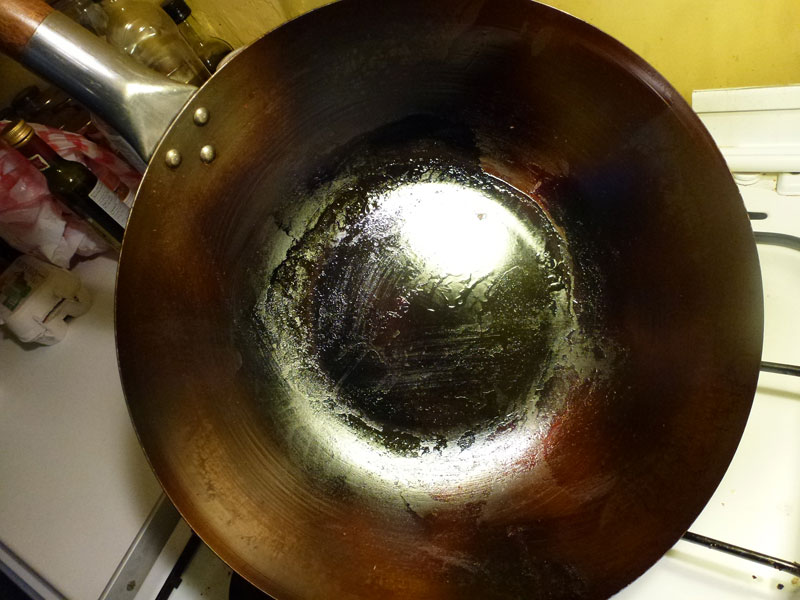
The instructions told us (once we'd scrubbed off the anti-rust layer with cream cleanser, rinsed and dried) to pour a tiny bit of vegetable oil in the wok and wipe it round with a kitchen towel to coat the inside thoroughly. Then you place it over a low heat until it darkens. Fifteen minutes they said, presumably not wishing to scare off novices. Fifteen minutes was enough to blacken the bottom (I bought a flat-bottomed one, otherwise you need a support ring — yet more equipment!) but nowhere near enough to affect the curved upper part.

After half an hour of this, he'd had enough and abandoned it to cool on the hob for another go later. (See first pic above)

While he was sulking, I cut to the chase, poured in more oil, slooshed it around (no namby-pamby kitchen roll for me) and emptied the excess down the sink. After shutting all doors and opening windows and back door, I then whacked up the flames on the biggest gas ring as far as they'd go until the oil was smoking: only then did the magic happen. You have to move it around and hold it at angles to make sure the sides get done, but it happens in front of your eyes so it's only a bit like watching paint dry.

To be totally safe (fire, flammable oil, soft human flesh, home) have a large metal lid and a damp tea-towel to hand, just in case. But you should be okay if you don't have more than a coating of oil.

It is now cooling down on the hob, ready for use. Every time you use it it will only get better.


Sunday, 11 July 2010

Nasi Goreng video: classic Asian rice & prawns plus chicken and satay sauce, Part 1

PART 1 (PART 2 plus recipe HERE) My friend Denise made us a wonderful meal last week. Nasi Goreng is a traditional Indonesian fried rice dish made with prawns, ginger, garlic, chilli and tamarind among a myriad of other tasty ingredients. We're serving it with roast chicken with a tasty peanut satay sauce with ginger, garlic, chillies and onion. Here's how to cook Nasi Goreng in an easy two part video (second part here). Plus a satay sauce made simple but absolutely mouthwatering. Served over roasted chicken pieces and fried savoury rice. Strong pungent flavours for those who like their taste buds given a good time. Interruptions by various males never knocked us off our true course: bringing you the best of Asian cooking. Amazing how much focus you have when you're hungry. Part one of two parts. Part 2 here.

Wednesday, 30 June 2010

Perfect boiled rice — the easy way

For years, I've been simultaneously puzzled, astonished and amused by those who boil their rice in an excess of water, then drain and wash out the starch under running hot water. Never mind that hot water from the boiler adds copper from the pipes — not exactly the healthy option — what madness is this?

Yes, I know lots of Chinese now use electric rice-steamers, but I prefer to cook mine the analogue way. Apart from not having the room for storage (mine is somewhere deep in the bowels of the shed), it's the culinary difference between driving automatic and manual.

Preferring the feel of the gear stick in my hand, here's how I do it.

First, choose your rice.

The easiest and quickest to cook is white rice. I was brought up on long grain American rice but I really like white basmati and fragrant Thai. The problem is that, being refined, with the husk and nutrients that sit just under the skin removed, you get a hypoglycaemic hit as all those carbohydrates make demands on your poor old pancreas to pump out insulin.

However, working on the principle that a little of what you fancy is what the doctor ordered, enjoy it but maybe not every day.

I usually use organic brown basmati as I get the nutrients plus roughage and it doesn't take quite as long to cook as standard brown rice.

A mug of rice for two peopleFor two people, add about a mug of dry raw rice to a small saucepan and give it a rinse under cold running water. White rice has a lot of loose starch on the surface so you'll have to do this several times, swirling it with your hand, until the water runs clear.


Add water to depth of one knuckleThen, instead of fiddly measuring devices, add water up to a depth of one knuckle above the white rice.

No matter how much you cook, the principle is one knuckle depth of water above the rice. This is true of white, but for some strange reason, it's a little less with brown. About three-quarters should do it.

Chicken stock cube and boiling riceAdd a sprinkle of salt or low-sodium salt. I cheat and crumble in one Kallo organic chicken stock cube.

Place a tight lid on top and bring to the boil over a high heat. Then turn all the way down — you want the lowest heat so make sure the pan is on the smallest ring. Simmer for 15 minutes for white Thai fragrant and basmati, 20 minutes for long-grain white rice, 40 minutes for organic brown basmati, and ten years, I mean, 50 minutes for standard brown rice.

Whatever you do, DO NOT remove the lid and have a poke around. Control your curiosity and trust me. If you have a glass lid, you'll see little steam holes appearing in the rice as the water is absorbed. If not, think of Schrodinger's Cat. It is both cooked and not cooked until the moment you are allowed to peek. (Dear lord, now I've mentioned cat in a recipe!)

perfect fluffy boiled riceRemove from the heat at the end of the cooking time, open the lid and give it a stir with a wooden spoon or spatula, and immediately replace the lid so it can continue to steam under its own steam for another five minutes and fluff up.

There it is, via the traditional Asian method. Serve with something delicious from this blog.

FOOD SAFETY: There's a technique for removing the arsenic found in rice that Sheffield scientists came up with in 2020. Add raw rice to boiling water and boil for five minutes. Drain (BBC viewers can find comfort in washing under cold running water at this point) and add enough boiling water from the kettle to bring it up to the depth of one knuckle above the rice as above. Because it is hot, do not use your actual knuckle at this stage but measure it with an implement and measure that against your finger. Add lid, bring back to the boil for the usual time minus the five minutes.

EQUIPMENT NOTE: If you don't want to burn your rice, use a pan with a thicker base. I use a steel pan with a thick copper base. But if the rice does catch, Chinese people like the crispy bits, as long as it's not burnt to the point of being bitter.

Thursday, 24 June 2010

Instant Japanese miso soup for breakfast

Japanese miso soup for breakfastInstant. Usually a word to strike terror into the heart of a proper foodie when prefacing consumables such as “coffee”. But, as when it renders “gratification” immediate, “instant’ is not always a bad thing.

Just so here. In the pic, instant Japanese miso soup in Chinese mugs. How’s that for cultural fusion? Ideal for when you can’t face a full-on English breakfast but fancy a savoury hit.

Miso soup is usually found as an accompaniment to Japanese meals. It is light and comes in a variety of forms, always containing healthy seaweed.

The mug on the left contains Tofu Miso Soup, containing red and white miso soybean paste and tiny tofu chunks, and is made by adding hot water to the dehydrated ingredients. It also contains seaweed, green onion, kelp, bonito (fish) and, sadly, monosodium glutamate (MSG a sodium salt originally made from healthy seaweed but not healthy itself). Powdered kelp and bonito make up the traditional dashi stock when you add hot water.

The other miso soup comes in a fancier double sachet, with the miso in the form of a paste rather than dehydrated, and also contains spring onion, wakame seaweed and, ahem, “flavourings”.

The ingredients aren’t held in suspension so you need a spoon to get to the bits at the bottom

BTW, the mugs can be found for around £3 in Chinese supermarkets. They come with matching lids to keep your drink hot — ingenious but simple. I particularly like the blue and white rice-grain one on the left as it is thinner porcelain and doesn’t draw out the heat like lots of china. Similar to bone china, but not as delicate or expensive, this property means that you get a good cuppa tea even with a tea-bag. (Make mine a Picard Special: Tea! Earl Grey! Hot!)

(Brought over from WordPress)